January 15, 2008
CHNM to host inaugural THATCamp, May 31 - June 1, 2008
CHNM is pleased to announce its latest initiative, THATCamp.
Short for “The Humanities and Technology Camp”, THATCamp is a BarCamp-style, user-generated “unconference” on digital humanities. THATCamp is organized and hosted by the Center for History and New Media at George Mason University, Digital Campus, and THATPodcast.
What is an “unconference”?
According to Wikipedia, an unconference is “a conference where the content of the sessions is created and managed by the participants, generally day-by-day during the course of the event, rather than by one or more organizers in advance of the event.” An unconference is not a spectator event. Participants in an unconference are expected to present their work, share their knowledge, and actively collaborate with fellow participants rather than simply attend. There are many styles of unconferences. The most famous is probably BarCamp, an international network of unconference events focused largely on open source web development.
What should I present?
That’s up to you. Sessions at THATCamp will range from full-blown papers (not many of those, we hope) to software demos to training sessions to debates to discussions of research findings to half-baked rants. You should come to THATCamp with something in mind, and on the first day find a time, a place, and people to share it with. Once you’re at THATCamp, you may also find people with similar topics and interests to team up with for a joint session.
How do I sign up?
Unfortunately, we only have space for about 40-45 participants, so we’ll have to do some vetting. To apply for a spot, simply send us an email saying who you are, what you're thinking about presenting, and what you think you will get out of the experience. Please don’t send full proposals. We’re talking about an informal email of maybe 200 or 300 words, max. If you want to attach a C.V., that’s OK too. Send your email to thatcamp.info@gmail.com. Applications will close on March 15, 2008.
Where?
The Center for History and New Media, George Mason University, 4400 University Drive, MSN 1E7 Fairfax, Virginia.
When?
May 31 - June 1, 2008.
Who?
Anyone with energy and an interest in digital humanities.
How much?
As with most BarCamps, THATCamp will be free to all attendees. But a $25 donation towards snacks and diet coke will be much appreciated by the organizers.
How do I sponsor THATCamp?
A limited number of sponsorships are available to corporations and non-profits. Please send an email to thatcamp.info@gmail.com.
New ECHO Gateway for the History of Science, Technology, and Industry
The Center for History and New Media is pleased to announce the relaunch of the ECHO (Exploring and Collecting History Online) website. ECHO is a portal to over 5,000 websites concerning the history of science, technology, and industry. In addition to better helping researchers find the exact information they need and granting curious browsers a forum for exploration, the new site also provides access to the latest in blogging on the topics of digital history and histories of science, technology and industry.
The project is based at the Center for History and New Media at George Mason University. ECHO has been funded by two generous grants from the Alfred P. Sloan Foundation.
CHNM and American Historical Association Announce New Prize
Roy Rosenzweig Prize in History and New Media Established in Professor’s Memory
The Center for History and New Media (CHNM) and the American Historical Association (AHA) have agreed to institute a joint "Roy Rosenzweig Prize in History and New Media." The Rosenzweig Prize will be awarded annually for an innovative and freely available new media project that reflects thoughtful, critical, and rigorous engagement with technology and the practice of history.
Roy Rosenzweig died from cancer on 11 October 2007. He was the recipient of a Guggenheim Fellowship and lectured as a Fulbright professor. As the AHA’s Vice President for Research, he urged the Association to open all book prizes to publications in new media form. The Rosenzweig Prize will be the first to specifically recognize contributions developed in digital form to the profession at large.
In 2005, Rosenzweig’s Web-based project, History Matters earned him and CHNM the James Harvey Robinson Prize of the American Historical Association. In 2003, he was awarded the second Richard W. Lyman Award for his work with CHNM, particularly History Matters and the September 11 Digital Archive.
The AHA and the CHNM together will select members of the prize selection committee and develop prize guidelines. The award winners will be announced at the AHA’s Annual Meeting.
The George Mason University Foundation, Inc. will manage the funds for the Rosenzweig Prize. Contributions may be tax deductible to the full extent allowable by the law.
Gifts for the AHA/CHNM Rosenzweig Pize may be mailed to:
GMU Foundation, Inc.
4400 University Drive, MS 1A3
Fairfax, VA 22030
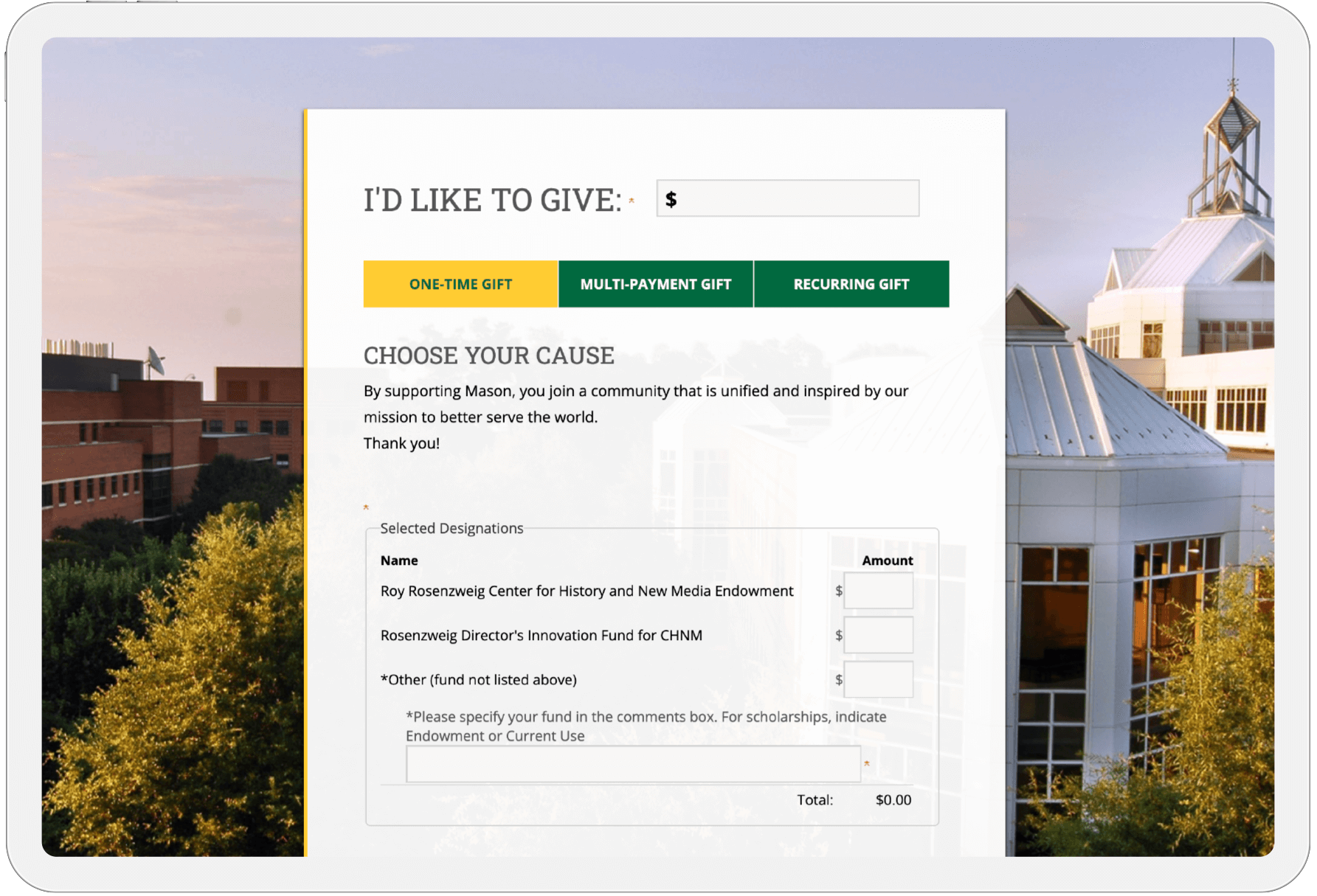
Checks should be made payable to the GMU Foundation, Inc. and indicate that the gift is for the AHA/CHNM Rosenzweig Prize. Gifts may also be made online at give.gmu.edu, but funds must be specified for the AHA/CHNM Rosenzweig Prize in the comments section.
For questions or information on alternate methods of giving, individuals should contact:
Heidi A. Bruce, Director of Development, College of Humanities and Social Sciences
Phone: 703.993.9319, e-mail: hbruce@gmu.edu
Contributions may also count toward the Center’s National Endowment for the Humanities (NEH) matching grant in accordance with NEH guidelines.
About the Center for History and New Media
Since 1994, the Center for History and New Media (CHNM) at George Mason University has used digital media and computer technology to democratize history—to incorporate multiple voices, reach diverse audiences and encourage popular participation in presenting and preserving the past. CHNM combines cutting edge digital media with the latest and best historical scholarship to promote an inclusive and democratic understanding of the past as well as a broad historical literacy. CHNM’s work has been recognized with major awards and grants from the American Historical Association, the National Humanities Center, the National Endowment for the Humanities, the U.S. Department of Education, the Library of Congress, and the Sloan, Mellon, Hewlett, Rockefeller, Gould, Delmas and Kellogg foundations.
About the American Historical Association
The American Historical Association (AHA) is a nonprofit membership organization founded in 1884 and incorporated by Congress in 1889 for the promotion of historical studies, the collection and preservation of historical documents and artifacts, and the dissemination of historical research. As the largest historical society in the United States, the AHA provides leadership and advocacy for the profession, fights to ensure academic freedom, monitors professional standards, spearheads essential research in the field, and provides resources and services to help its members succeed. The AHA serves more than 14,000 history professionals, representing every historical period and geographical area. As the only national association for historians studying all areas and fields of history, the AHA currently confers 25 prizes and awards, recognizing a wide variety of distinguished historical work in the form of books, distinguished teaching, and even film. Since 1896 the Association has conferred 1,276 awards that represent a catalogue of the best work of the historical profession over the past 111 years.
January 12, 2008
Washington Times on Omeka
CHNM and its new platform for publishing collections and exhibits online, Omeka, were featured this week in the Washington Times.
Describing CHNM as being "at the forefront of the new wave of collecting history," the article went on to highlight the September 11 Digital Archive, the Hurricane Digital Memory Bank, and History Matters. Virginia Tech's April 16 Archive, which runs on the Omeka platform, was also mentioned.
January 03, 2008
Cohen, Zotero appear in Washington Post
CHNM's Zotero project and CHNM's Director, Dan Cohen both appeared on Page A1 in Sunday's Washington Post over the weekend. Entitled "Internet Access Is Only Prerequisite For More and More College Classes," the front page article examined new trends in online education at institutions of higher learning across the country. Commenting on Zotero in particular and new campus technology initiatives in general, Cohen was quoted as saying "It's part of this movement in higher education to open up ... to share the products of our research, to be here for the public good."January 02, 2008
Zotero joins forces with Internet Archive, wins major grant
Although libraries have dedicated much of their time to scanning and cataloguing their materials for online access, both the expense and time of such projects have prevented many documents from being readily available.
Yet, in many cases, these documents have been scanned, copied or photographed by someone, somewhere. Virtually every professor, graduate student and author maintains major private caches of these materials from their own research. Biographers have scores of letters, pictures and ephemera. Architects and architectural historians have photographs of buildings from around the world. Scholars of literature have scanned diaries and manuscripts for insights into the writing process of those they study.
“This ‘hidden archive’ likely rivals existing online collections,” says Dan Cohen, director of the Center for History and New Media (CHNM). “We asked: What if there was a way to expose and share this tremendous hidden archive with scholars from around the globe?”
And now there is. CHNM has joined forces with the Internet Archive on a project funded by the Andrew W. Mellon Foundation to provide what could potentially be the world’s largest structured archival and access environment for scholarly material.
Introduced last year as open-source software that works within the popular Firefox web browser, the CHNM’s Zotero stores references and notes in the same way that other citation managers do. However, what makes Zotero unique from similar tools is its intuitive, iTunes-like interface and the fact that it runs in the web browser, allowing it to sense, record and share scholarly information on the web.
Now Zotero is teaming up with the Internet Archive to provide a seamless system for archiving, public sharing and collaborating within the scholarly community.
Under the new partnership, scholars will be able to easily drag and drop documents into the “Zotero Commons” and, after filling out legal information that ensures the document is in public domain, have the document uploaded to be searchable and accessible to anyone in the world.
A major incentive for scholars to participate in this project is that the Internet Archive will provide them with free optical character recognition (OCR) — that is, a transcription of the words on each scan — for documents that are donated, a tremendous benefit that will allow them to search and organize their own collection.
“Most scholars have not yet figured out how to take full advantage of the digitized riches suddenly available on their computers,” says Cohen. “The abundance of digital documents is actually overwhelming to some. Moreover, the major advantage of digital research — the ability to scan large masses of text quickly — is often unavailable to scholars who’ve done their own scanning or copying of texts. Yet after uploading to Zotero Commons, they will be able to search their own library very easily.”
Another function of the project will be the availability for scholars to share documents with a smaller, defined and secure community, allowing for easier collaboration across long distances.
The initial functionality of Zotero Commons will be rolled out in 2008.